How Things Actually Work
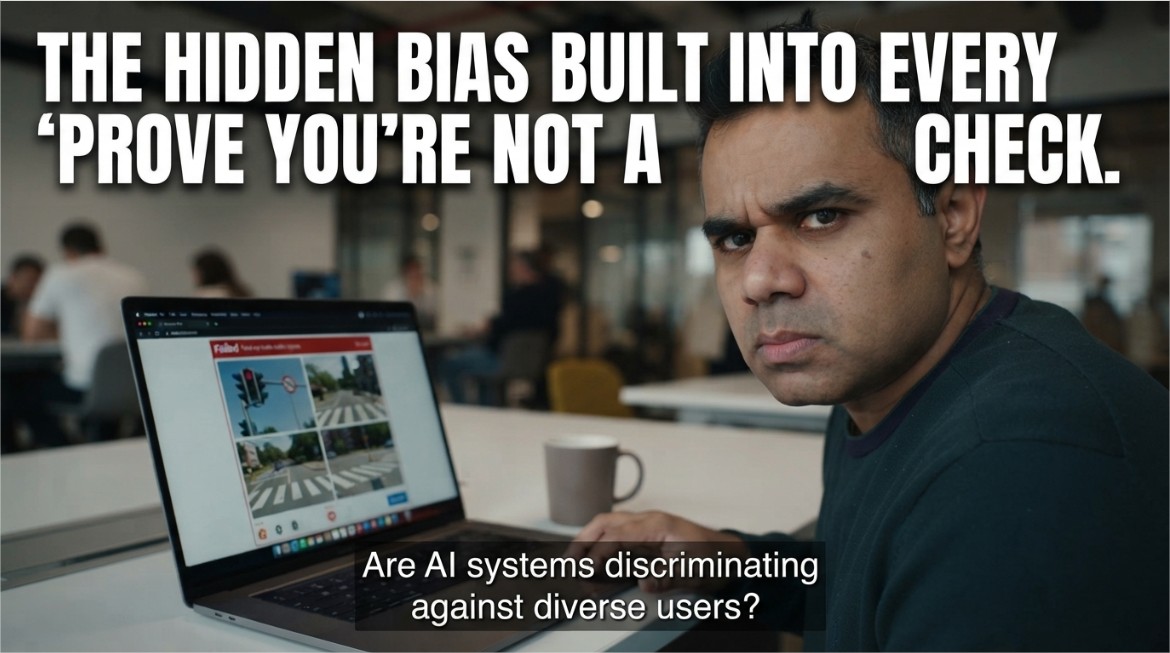
Some days you check a box and you're through instantly. Other days you're squinting at nine blurry photos of a crosswalk. You didn't get unluckier. Something about you scored differently, and you were never told the rules. This article explains how the modern version behind most invisible CAPTCHA checks actually works: a continuously calculated risk score between 0.0 and 1.0, based on mouse movement, timing, and interaction patterns, computed before a visible puzzle ever appears, with each website setting its own threshold for what counts as safe enough. It walks through what gets measured to build that score, and — the part rarely mentioned alongside the "invisible and frictionless" marketing — who ends up scoring lower through no fault of their own: keyboard-only navigators, screen reader users, VPN users, and brand-new visitors with no browsing history for the model to draw on. It closes with genuinely useful, honest habits that nudge a legitimate visitor's score in the right direction, without pretending there's a trick to game a system built to stay deliberately opaque.
📋 Table of Contents
- The Assumption Almost Everyone Makes About CAPTCHAs
- There's No Pass or Fail. There's a Number.
- What's Actually Being Measured Before You Notice Anything
- Who Ends Up Scoring Low Through No Fault of Their Own
- The Website Decides What Your Score Is Worth, Not Google
- What Actually Helps If You're Tired of the Traffic Lights
Almost everyone assumes a CAPTCHA works like a single locked door: you either solve the puzzle correctly and get through, or you fail it and get stuck. That mental model made sense a decade ago. It's mostly wrong today, and the actual system quietly replacing it is stranger, more invisible, and honestly more interesting than "type the wobbly letters."
1. The Assumption Almost Everyone Makes About CAPTCHAs
The version of CAPTCHA most people picture — distorted text, or a grid of photos asking you to click every square with a traffic light — is technically still around, but on a huge share of modern websites, it's not the primary check anymore. It's the fallback. The thing that shows up specifically when something else, running silently before you ever saw a puzzle, already decided it wasn't sure about you.
2. There's No Pass or Fail. There's a Number.
The modern version of Google's CAPTCHA system, generally referred to as v3, doesn't grade you pass or fail at all. It assigns a score — a number between 0.0 and 1.0 — where scores closer to 1.0 suggest ordinary human behavior and scores closer to 0.0 suggest something automated or suspicious. That score gets calculated continuously, in the background, often before you've clicked a single button, and it's based on interaction patterns Google's system has learned by watching an enormous volume of traffic across countless other websites.
3. What's Actually Being Measured Before You Notice Anything
The scoring system isn't reading the content of what you type. It's watching how you arrived at the moment of typing at all — mouse movement patterns, how a page was scrolled, timing between actions, whether interactions look like the smooth, slightly irregular rhythm of a person versus the mechanically consistent pace of an automated script. None of this requires you to do anything differently. It's happening whether or not a visible box or puzzle ever appears on your screen.
This is precisely why the system can run invisibly on so many sites without asking anything of the visitor at all — the visible challenge only shows up as a second layer, reserved specifically for sessions the invisible score already flagged as uncertain.
4. Who Ends Up Scoring Low Through No Fault of Their Own
Here's the part that rarely gets mentioned alongside the "invisible and frictionless" marketing pitch: a scoring system built around what "normal human behavior" looks like on average will, almost by definition, be less confident about people whose behavior doesn't match that average — not because they're doing anything wrong, but because their patterns simply diverge from the majority the model was trained on.
- Users navigating primarily by keyboard rather than mouse, whose interaction rhythm looks unusual to a system calibrated mostly on mouse-driven behavior.
- People using screen readers or other assistive technology, which can produce interaction timing that looks atypical to the underlying model.
- Anyone connecting through a VPN, shared corporate network, or an IP address with a messier reputation history for reasons that have nothing to do with them personally.
- Brand-new visitors with no browsing history for the scoring model to draw context from, since the system leans on accumulated behavioral signal over a session, and a fresh visit simply has less of it to work with.
None of these people are doing anything resembling bot behavior. They're just further from the statistical center of what the model treats as the default, and the fallback puzzle is what quietly catches the gap.
5. The Website Decides What Your Score Is Worth, Not Google
It's worth being clear about where responsibility actually sits here, because it's easy to assume Google's system is making a final verdict about you personally. It isn't, not exactly. Google hands back a number. The website you're visiting is the one that decided, in advance, what to do with that number — block outright, allow through silently, or throw up a visual puzzle as a tiebreaker. Two different sites can receive the identical score for the identical visit and make completely different decisions about what it means.
That also means a frustrating run of traffic-light puzzles isn't necessarily a verdict on you specifically. It might just mean the particular site you're on set a stricter bar than the last five you visited without noticing any friction at all.
6. What Actually Helps If You're Tired of the Traffic Lights
There's no trick that guarantees a perfect score every time, since the scoring model is deliberately kept private and constantly evolving. A few things do genuinely help shift the odds in a normal, honest direction, though — not by gaming the system, just by looking less like the edge cases it struggles to read confidently.
- Avoid stacking a VPN with other privacy tools simultaneously on forms you actually need to complete — each additional layer of obfuscation is one more signal the model has less context to interpret correctly.
- Let a page fully load and settle for a moment before immediately interacting with a form — a burst of instant, mechanically-fast input right at page load is exactly the pattern automated scripts produce.
- Keep your browser reasonably up to date — very old or unusually configured browser environments give the model less familiar signal to work with, which nudges uncertainty in the wrong direction.
- If a site persistently struggles to pass you, try it on a normal home connection rather than a shared public or corporate network before assuming something's wrong with your device specifically.
None of this is about beating a security system — it's a legitimate visitor's traffic just happening to sit closer to the center of what the model already trusts. The puzzle was never really testing whether you're a human. It was testing whether you look enough like the millions of other humans the system has already learned to recognize, and that's a meaningfully different, much less flattering question than the one most people assume they're being asked.
Explore More Awareness & Security Content
Discover more security tips, threat analysis, hacking awareness, and practical guides designed to help you stay safe online.
Visit Awareness & Security →