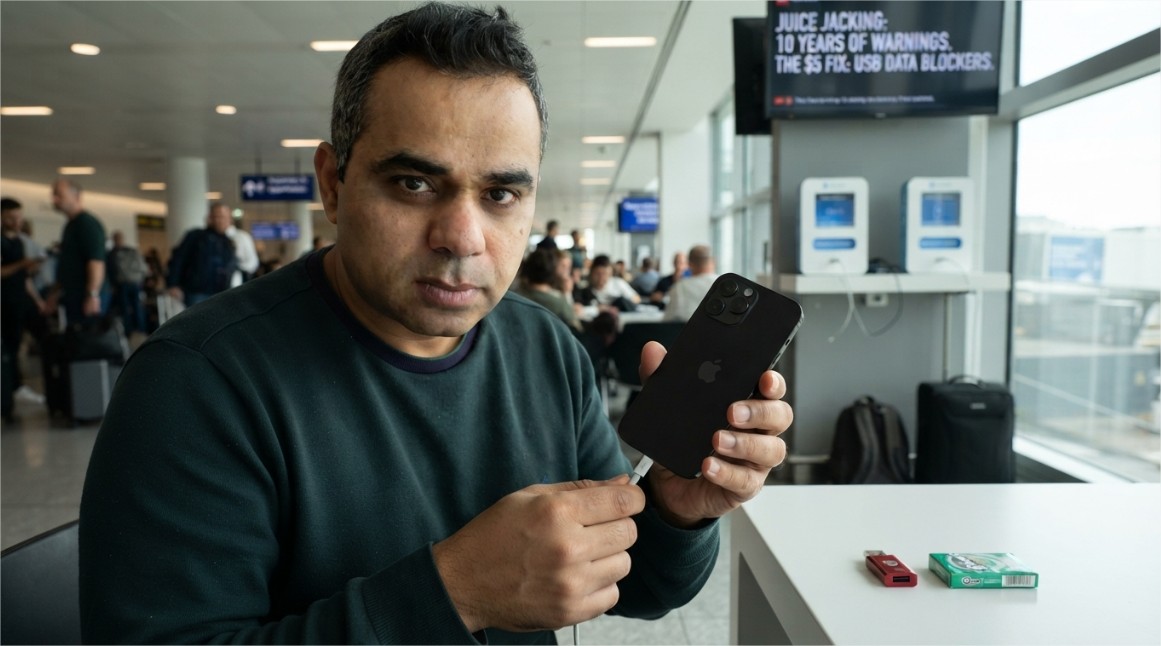
Public Wi-Fi & Travel Security
Juice Jacking Is Real, Technically. It's Also Never Actually Happened to Anyone, Apparently.
The FBI has warned about it. The FCC has warned about it. Even the TSA chimed in. And yet, after more than a decade of warnings, there's still no confirmed case of it happening in the wild. So what's actually going on here?. USB cables carry both power and data through the same wires, and security researchers proved the concept as far back as 2011. What rarely makes the headline, though, is that after more than a decade of repeated warnings, no agency has pointed to an actual confirmed case of it happening to a real traveler. This article walks through why the warnings keep recirculating anyway, what the actual risk looks like for an ordinary traveler versus a security researcher's worst-case scenario, and the handful of genuinely low-cost precautions — charge-only cables, USB data blockers, a personal wall charger — that make the debate almost beside the point, since taking them costs nothing regardless of how real you think the risk actually is
Every few months, a version of the same headline resurfaces: some government agency has issued a fresh warning about "juice jacking" — the idea that a public USB charging port at an airport or hotel could secretly install malware on your phone or steal your data while it charges. It sounds alarming. It also sounds, if you've heard it three or four times over the past decade, a little bit like the tech world's version of "don't swim right after eating."
So which is it — a real threat you're ignoring at your own risk, or a zombie scare story that refuses to die despite having no actual victims? The honest answer is a bit of both, and the distinction matters more than either extreme.
1. The Genuinely Real Part: How USB Cables Actually Work
Here's the part that isn't exaggerated at all: a standard USB cable carries both power and data through the same set of wires. Two of the internal wires deliver electricity to charge your battery; two others are dedicated to data transfer, the same pins that let your phone sync photos to a computer or transfer files. A charging port, in principle, has everything it needs to also attempt a data connection — nothing about "charging" technically prevents it.
Researchers demonstrated this at a security conference as far back as 2011, setting up public charging kiosks that would flash a warning message on anyone's phone the moment they plugged in, just to prove the concept worked. Malicious cables that behave normally for charging but secretly act as a keyboard or data-exfiltration device to a connected computer have been built and sold as proof-of-concept hacking tools since then too. None of this is speculation — the mechanism is completely real and has been demonstrated repeatedly under controlled conditions.
2. A Decade of Warnings, Zero Confirmed Cases
Here's the part that tends to get left out of the headline: despite the FBI, the FCC, and more recently the TSA all issuing public warnings about juice jacking, none of them have pointed to an actual documented case of it happening to a real traveler. When journalists have pressed for specifics after these advisories, the agencies involved have consistently confirmed the warnings were general precautions, not responses to a specific incident or a wave of reported victims.
3. So Why Do Agencies Keep Warning About It?
Partly, it's simple institutional caution — warning the public about a plausible, demonstrated attack method costs an agency very little, even if it never materializes at scale. It's also partly a media feedback loop: an agency posts a routine advisory, a news outlet picks it up because the concept is inherently attention-grabbing, other outlets follow, and a few years later a different agency reissues a nearly identical warning to a public that's already half-forgotten the last one. Each cycle looks like fresh evidence of a growing threat, when it's often the same underlying advisory recirculating in a new news cycle.
None of that makes the warnings dishonest. It just means "a government agency warned about this" is doing less evidentiary work than the headline implies.
4. What the Actual Risk Looks Like Today
Realistically, for the average traveler using a normal, well-trafficked public charging station at a major airport or hotel, the odds of encountering an actual compromised port remain low enough that security researchers who travel constantly for a living generally describe the risk as more theoretical than practical. That's a meaningfully different statement from "there's no risk at all" — cheap hardware to pull this off exists, and it would be inaccurate to claim it's impossible. It's a statement about probability, not about whether the attack is technically real.
The risk profile also isn't uniform. A charging station in a busy, well-monitored international airport terminal is a different proposition than an unbranded charging kiosk with no visible owner sitting in a random corner somewhere. Context matters more than the technology itself.
5. The Precautions That Cost You Nothing
Here's the genuinely useful part of this whole conversation: even though the documented real-world risk is low, the precautions are so cheap and simple that skipping them isn't really saving you anything meaningful.
- Carry your own small wall charger and plug directly into an electrical outlet — this sidesteps the entire data-pin issue since no data connection is ever made.
- Use a portable battery pack you charge separately at home — the most friction-free option for frequent travelers.
- Buy a charge-only USB cable, sometimes sold as a "power-only" cable, which physically lacks the data wires altogether — no data pins means no possible data attack, regardless of what the port on the other end is doing.
- Use a small USB data blocker adapter if you'd rather keep your existing cables — it sits between your cable and the port and physically blocks the data pins while allowing power through.
- If your phone shows a prompt asking whether to "trust this computer" or allow data access when you plug in, always decline it on an unfamiliar public port — a legitimate charging-only connection should never need this permission.
6. Treating This Like an Actual Risk Decision
The most useful way to think about juice jacking isn't "terrifying hidden threat" or "complete myth invented by bored government press offices." It's a real, demonstrated attack method with an apparently very low real-world incidence rate, paired with a set of precautions cheap enough that taking them costs you almost nothing regardless of how likely you think the risk actually is.
That's a genuinely different kind of security advice than most of what circulates online — not "be terrified," not "ignore the warnings," but "the insurance is basically free, so you might as well carry it." A five-dollar data blocker in your travel bag isn't really a bet on whether juice jacking is common. It's just a sensible habit that costs nothing to maintain, whether or not you ever encounter the thing it protects against.
Explore More Awareness & Security Content
Discover more security tips, threat analysis, hacking awareness, and practical guides designed to help you stay safe online.
Visit Awareness & Security →