Cybersecurity Awareness
Credential Stuffing: Why Reusing One Password Puts Every Account You Own at Risk
This attack doesn't guess your password. It already knows it — from a breach at a completely different company you've probably never connected in your mind.
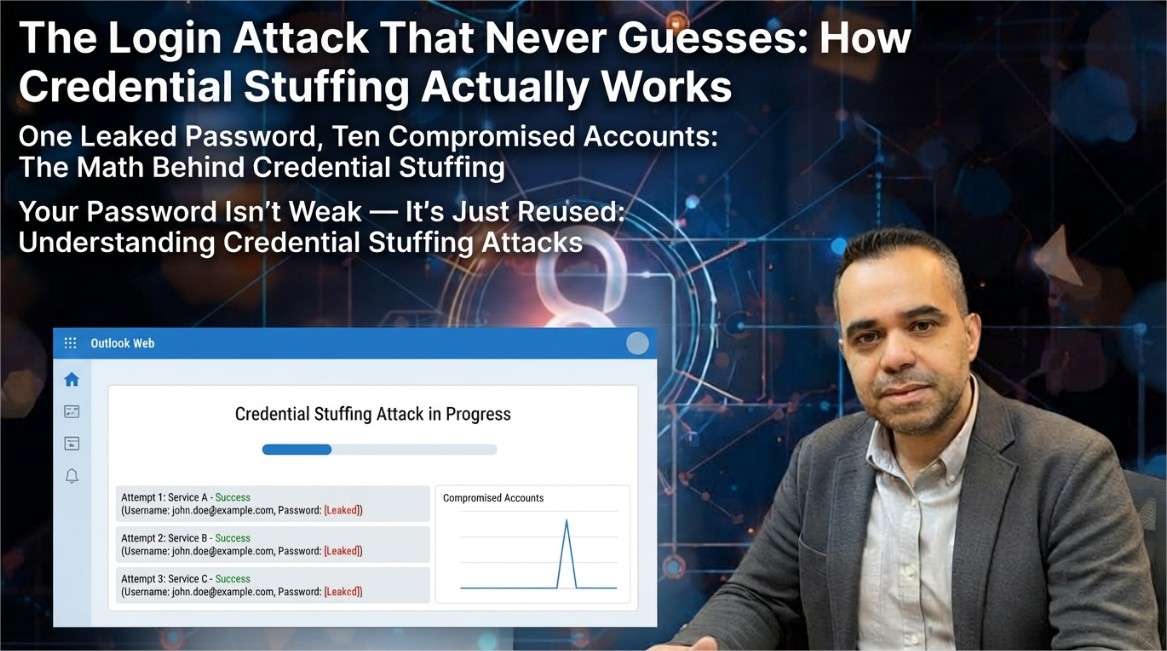
Most people picture password attacks as a hacker sitting at a screen, guessing combinations one at a time until something works. That image is almost entirely wrong for the attack that actually does the most damage today. Credential stuffing doesn't guess anything. It takes a password that is already known to be correct — because it leaked from an unrelated breach — and simply tries it somewhere else.
The mechanism is almost insultingly simple, and that simplicity is exactly why it remains so effective years after security teams first started warning about it.
1. Credential Stuffing vs. Brute Force: A Critical Distinction
Brute-force attacks and credential stuffing get lumped together constantly, but they solve completely different problems, and confusing the two leads to the wrong defenses.
A brute-force attack targets one account and tries many possible passwords against it — essentially guessing blind, constrained only by password complexity rules. It's slow, noisy, and increasingly blocked by simple rate limiting and account lockouts.
Credential stuffing flips this entirely. The attacker already has a large list of real email-and-password pairs, harvested from a previous data breach at some other company — a retailer, a forum, an old app you signed up for once and forgot about. Instead of guessing, they take that exact working password and try it against your accounts on completely different platforms: your email provider, your bank, your social media. No guessing is involved. The password isn't a guess — it's a fact, just applied to the wrong door.
2. The Reuse Math That Makes This Attack Work
The reason credential stuffing scales so well comes down to basic probability, not clever hacking. Consider what happens when a single set of breached credentials is tested against a list of popular platforms:
If a person reuses 1 password across 10 accounts,
and just 1 of those 10 services is ever breached,
the attacker now holds working keys to the other 9 — instantly, for free.
This is why credential stuffing tools don't need to be aimed at any specific person to be dangerous. An attacker doesn't need to know or care who you are. They run a breached list against login pages at scale, and whichever accounts happen to match — because someone reused a password — simply fall out the other end as confirmed hits. You become a target purely through statistical overlap, not because anyone chose you.
3. How the Attack Is Actually Carried Out
Breached credential lists circulate widely after major incidents, often compiled and re-shared long after the original breach was patched or disclosed. These lists are traded, combined with other leaked datasets, and eventually used as raw material for stuffing attempts.
From there, the process is largely mechanical rather than skillful: automated tools submit login attempts across many sites in rapid succession, cycling through the credential list against each target's login form. Because the attacker is testing thousands or millions of already-correct password guesses rather than random ones, even a modest success rate — a small single-digit percentage of accounts where reuse occurred — produces a meaningful number of compromised accounts when applied to a large enough list.
This piece is described here only at the mechanism level — what makes the attack effective — not as a working method, since the goal of understanding this is entirely defensive: recognizing why reuse is the actual vulnerability being exploited, not the login form itself.
4. Why This Is Hard for Companies to Block
From a defender's perspective, credential stuffing is uncomfortable precisely because every individual login attempt looks completely legitimate. The username and password are correct. There's no obvious sign of guessing, no repeated failed attempts against one account, no suspicious character patterns. The request looks exactly like what happens millions of times a day when real users log in successfully.
🎭 It Mimics Real Traffic
Each attempt uses a genuinely correct password, so simple failed-login monitoring rarely catches it on its own.
🌐 It's Distributed
Attempts are frequently spread across many IP addresses, making basic IP-based rate limiting far less effective.
📊 It Hides in Volume
Large platforms process enormous login volumes normally, so a spike has to be unusually large to stand out from ordinary traffic.
🔁 It's Reusable Infrastructure
The same breached list can be tested against dozens of unrelated platforms with no additional effort from the attacker.
5. Defending Your Own Accounts
The good news is that the defense here is unusually clear-cut, because the vulnerability is specific: password reuse. Removing reuse removes almost the entire attack.
- Use a unique password for every account — a password manager makes this practical without requiring memorization.
- Enable multi-factor authentication wherever it's offered, prioritizing an authenticator app or hardware key over SMS codes.
- Check whether your email address appears in known breach datasets using a reputable breach-notification service such as Have I Been Pwned, and change any reused passwords tied to affected accounts immediately.
- Pay particular attention to old, forgotten accounts — a password reused from a site you signed up for years ago and never think about is just as dangerous as one from an account you use daily.
- Where a platform supports passkeys instead of passwords, use them — a passkey cannot be reused across sites the way a text password can, because it isn't a shared secret to begin with.
6. Defending a Login System You Manage
If you operate a website or application with user accounts, the defensive posture looks different, because you can't control whether your users reuse passwords elsewhere — but you can control how your system responds to the pattern this attack produces.
- Implement rate limiting and progressive delays per account and per IP, rather than relying on either signal alone.
- Deploy device and behavioral fingerprinting to flag logins that succeed with correct credentials but come from an unfamiliar device, location, or browser configuration.
- Use CAPTCHA or equivalent challenge mechanisms specifically when anomalous login velocity is detected, rather than on every login attempt.
- Screen new and existing passwords against known breached-password datasets at signup and login, rejecting credentials that appear in public breach corpora.
- Offer — and actively encourage — multi-factor authentication and passkey support rather than treating them as optional add-ons buried in account settings.
- Monitor for the specific signature of credential stuffing: a high volume of login attempts with a low failure-to-success ratio spread across many accounts, rather than many failures against one account.
Conclusion
Credential stuffing persists not because it's technically sophisticated, but because it exploits something almost every internet user still does: reusing a password across more than one account. The attack requires no cleverness against your specific defenses — it only requires that a password you chose years ago, for a service you may not even remember, was correct somewhere else too.
The fix is narrower and more achievable than most security advice: eliminate reuse, add a second authentication factor, and treat old dormant accounts with the same seriousness as the ones you use every day. None of this requires deep technical expertise — it requires recognizing that the weak point was never the strength of any single password, but the decision to let one password answer for more than one account.
Explore More Awareness & Security Content
Discover more security tips, threat analysis, hacking awareness, and practical guides designed to help you stay safe online.
Visit Awareness & Security →