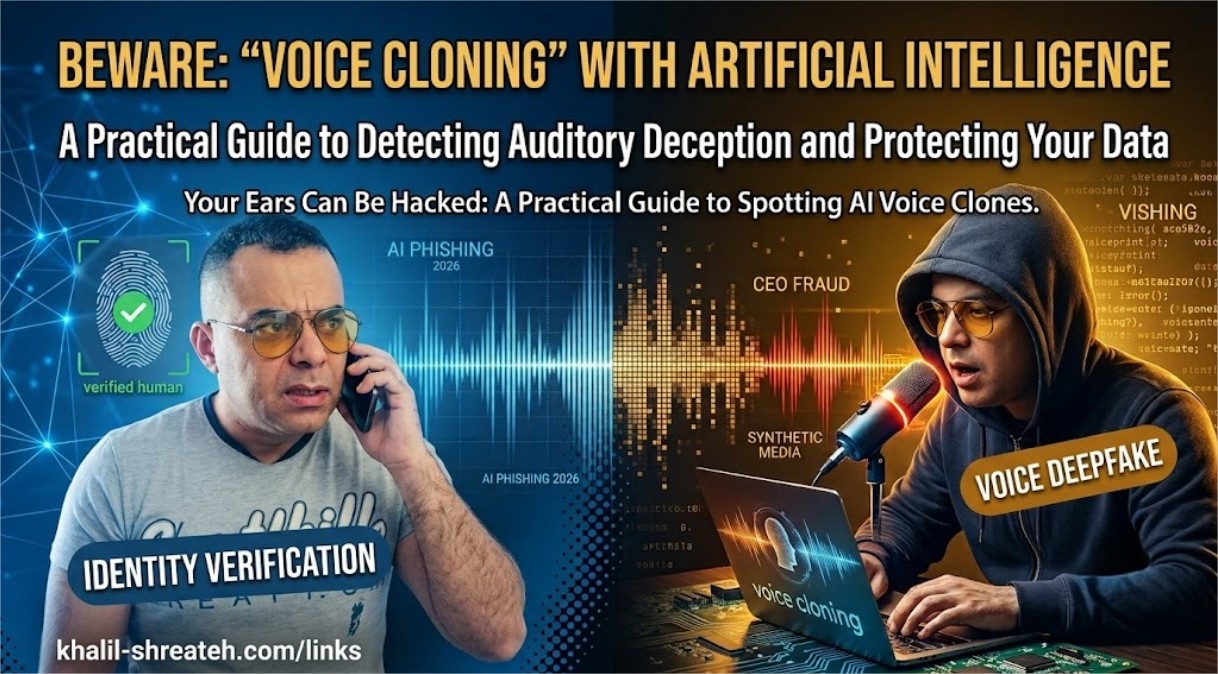
Cybersecurity Awareness
The Voice on the Phone Isn't Real: Inside the Rise of AI Deepfake Social Engineering
Attackers no longer need to guess your password — they can now clone your boss's voice, your daughter's face, or your CEO's video call in seconds. Here's how, and how to fight back.
Picture this: your phone rings. It's your son. His voice is shaking. He says he's been in an accident and needs money transferred immediately. Every inflection, every nervous pause, sounds exactly like him — because it is his voice. Except he never made this call. Somewhere, an attacker fed a short clip of audio scraped from a social media video into an AI model, and produced a convincing vocal clone in under a minute.
This is no longer science fiction. It is one of the fastest-growing categories of fraud, and it has quietly made an entire generation of trusted verification methods — a familiar voice, a recognizable face on a video call — far less reliable than most people assume.
1. A New Kind of Attack Surface
For decades, security training taught us to trust our senses. If you heard your manager's voice, it was your manager. If you saw a colleague on a video call, it was your colleague. Generative AI has quietly dismantled that assumption, and most organizations have not caught up.
What makes this threat category especially dangerous is that it doesn't exploit a flaw in your software — it exploits a flaw in human trust itself. No firewall, antivirus, or password policy can stop an employee from believing their own eyes and ears.
2. How AI Voice & Video Cloning Actually Works
Understanding the mechanics behind these attacks removes their mystery — and makes them far easier to defend against.
Voice Cloning
Modern voice-synthesis models need only a short sample of clean audio to build a convincing vocal profile. Attackers harvest this audio from publicly available sources: YouTube videos, Instagram stories, voicemail greetings, podcast appearances, or even a brief phone call where the target says almost nothing meaningful. The model then learns pitch, cadence, accent, and speech patterns, and can generate entirely new sentences in that voice — including sentences the real person never said.
Video Deepfakes
Real-time face-swapping tools can now overlay a synthetic face onto a live video feed during an actual video call, matching lip movement, blinking, and lighting convincingly enough to pass a casual glance — and increasingly, even a careful one.
3. Five Real Deepfake Attack Scenarios
👔 CEO Fraud (Vishing)
An employee receives an urgent "call" from a cloned executive voice demanding an immediate wire transfer, bypassing normal approval channels.
👨👩👧 Family Emergency Scam
A cloned voice of a relative claims to be in danger, arrested, or hospitalized, pressuring the victim into sending money within minutes.
📹 Fake Video Conference
Attackers join a live video call using a real-time deepfake of a trusted colleague or executive to authorize a fraudulent transaction.
🗳️ Disinformation Clips
Fabricated video statements attributed to public figures or company leaders spread rapidly, damaging reputations before they can be debunked.
🔓 Biometric Bypass
Synthetic voice or face data is used to attempt to bypass voice-authentication banking systems or facial-recognition login checks.
4. Case Study: The $25.6 Million Video Call
In one of the most well-documented incidents to date, a finance employee at the Hong Kong office of Arup — a London-based engineering firm behind projects like the Sydney Opera House — joined what appeared to be a routine video conference with several senior colleagues, including the company's CFO. Every participant on the call except the employee was an AI-generated deepfake, built from publicly available video and audio of the real executives.
Believing the instructions came directly from leadership on a live video call, the employee carried out fifteen transfers totaling roughly $25.6 million (HK$200 million) before the fraud was discovered. No malware was involved. No system was breached. The entire attack succeeded purely by exploiting trust in familiar faces and voices — Hong Kong police later confirmed the case at a public briefing, and Arup itself confirmed the incident to reporters.
5. How to Detect a Deepfake in Real Time
While detection tools are improving, the most reliable defenses right now are behavioral, not technical. Train yourself to notice these warning signs during suspicious calls or video meetings:
- Unnatural pauses or slightly robotic rhythm in speech, especially during emotional moments.
- Audio that sounds slightly "flat" or lacks background ambience consistent with the claimed location.
- On video: unnatural blinking patterns, inconsistent lighting on the face versus the background, or blurring around the jawline and hairline.
- Lip movement that is slightly out of sync with the audio, particularly on fast or complex words.
- Extreme urgency combined with a request to bypass normal verification or approval steps.
- Reluctance or a poor excuse when asked to do something unscripted, like turning their head or answering a personal question only the real person would know.
6. Building Personal & Organizational Defenses
The good news: defending against deepfake social engineering does not require exotic technology. It requires deliberate process design, because the vulnerability being exploited is procedural, not technical.
For Individuals
- Establish a family "safe word" that must be used to verify identity during any emergency phone call.
- Never act on a financial request received solely by phone or video — always verify through a separate, previously known channel.
- Limit publicly posted audio and video of yourself and family members where practical, especially clear voice recordings.
- If a call feels urgent and emotionally charged, treat that urgency itself as a red flag, not a reason to act faster.
For Organizations
- Require dual-channel verification for any financial transaction above a defined threshold, regardless of who appears to be requesting it.
- Establish a callback policy: verify unusual requests by calling a known, pre-saved number — never a number provided during the suspicious call itself.
- Train employees specifically on deepfake tactics, not just traditional phishing, as part of regular security awareness programs.
- Adopt a "no urgent exceptions" culture where bypassing standard approval processes always requires additional verification, not less.
- Use pre-agreed verification phrases for high-stakes video calls involving executives or financial decisions.
Conclusion
For most of human history, seeing and hearing someone was proof enough of who they were. That assumption has quietly weakened, and very few institutions, families, or individuals have updated their instincts to match. The technology behind deepfakes will keep improving, and detection will always be playing catch-up.
The only defense that scales is procedural: verification steps that do not depend on trusting a voice or a face, no matter how convincing. Build that habit now, before the phone rings with a voice you recognize, asking for something you shouldn't give.
Explore More Awareness & Security Content
Discover more security tips, threat analysis, hacking awareness, and practical guides designed to help you stay safe online.
Visit Awareness & Security →