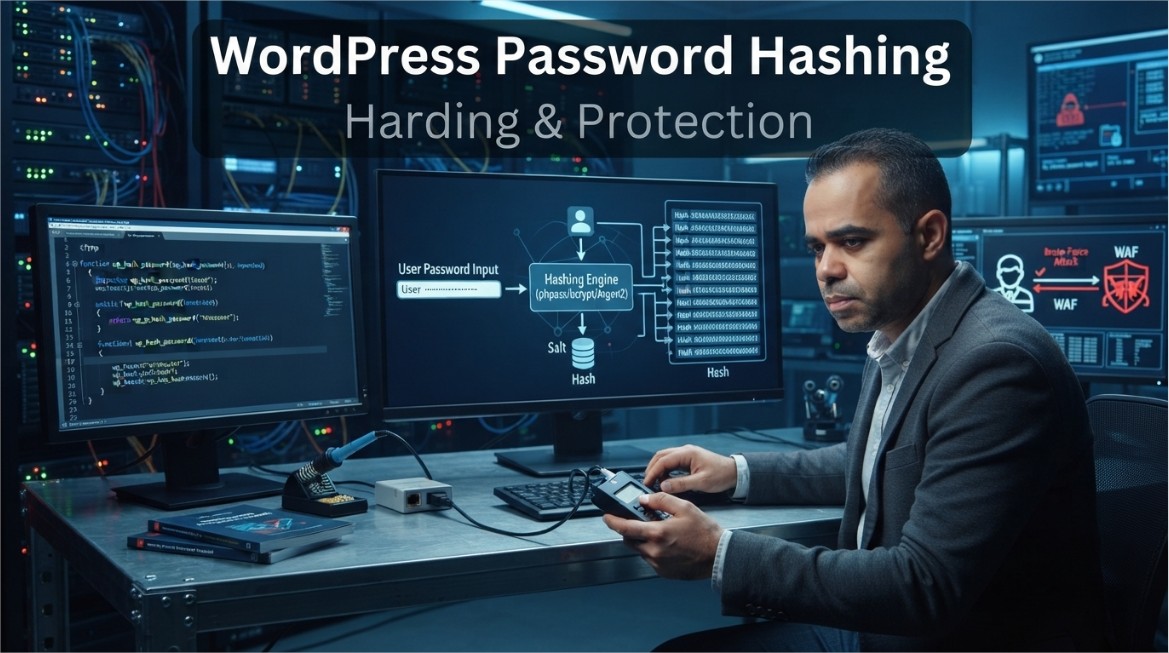
WordPress never stores your actual password — it stores a cryptographic hash of it. If an attacker gets access to your database (through a separate vulnerability like SQL injection, a misconfigured backup, or a compromised plugin), the real risk isn't that they can "read" your password — it's whether the hash is weak enough to crack, and whether your site's configuration gives them an easy path to steal that database in the first place.
Why This Matters
Modern WordPress uses a strong hashing scheme (based on the industry-standard Portable PHP password hashing framework), which is resistant to fast brute-force cracking when configured correctly. Older or heavily modified installations, or sites still running badly outdated WordPress core versions, are where this becomes a real risk — outdated hashing schemes are far more crackable with modern hardware.
How to Actually Harden This
- Keep WordPress core, themes, and plugins fully updated. Most real-world WordPress compromises start with an outdated plugin vulnerability, not a hashing weakness — patching is your highest-leverage defense.
- Restrict access to
wp-config.php. This file holds your database credentials. Set its permissions to644(readable but not writable by other users) and, ideally, move it one directory above your web root if your hosting setup supports it. - Password-protect your
/wp-admin/directory with an additional layer of authentication (via.htaccessand a separate password) — this means even a valid stolen WordPress password isn't enough on its own to reach the login form. - Enforce strong, unique passwords for every account — a strong password makes the underlying hash largely irrelevant to crack in practice, since brute-forcing a long random password remains computationally infeasible regardless of hashing scheme.
- Enable two-factor authentication via a security plugin — this means even a fully compromised password (hash cracked or otherwise obtained) isn't sufficient to log in.
- Limit login attempts to prevent brute-force guessing against the login form directly, separate from any database-level concern.
The Real Lesson
The password hash itself is rarely the weak link in a well-maintained WordPress site — the actual risk is almost always an outdated plugin, a misconfigured file permission, or a weak individual password. Hardening those first does far more for your site's security than worrying about the hashing algorithm in isolation.