
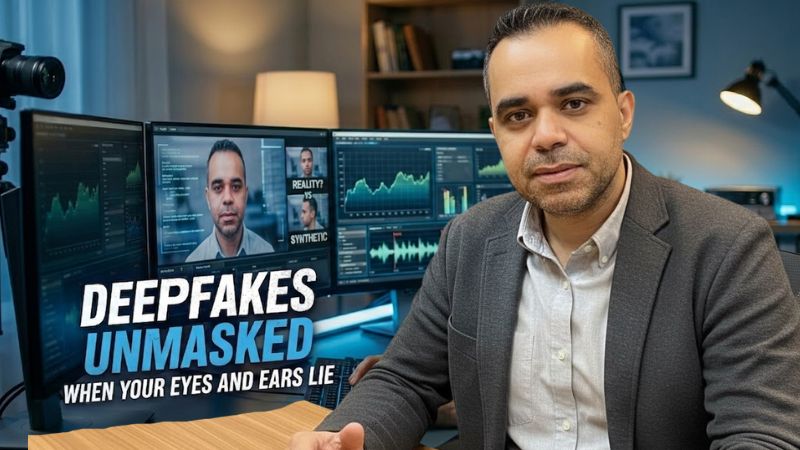
"One moment of inattention could cost you your reputation, your money, or even your freedom."
📱 Introduction: When a Pixel Becomes a Lie
Imagine your phone rings. It's your closest friend's number. You answer, and you hear their voice perfectly — their tone, their breathing, even their distinctive laugh. They urgently ask you to transfer money to "rescue a situation that cannot wait." Would you doubt for even a single second that the voice on the other end isn't real?
With the rapid advancement of generative artificial intelligence, deepfake technology is no longer the exclusive domain of Hollywood blockbusters or intelligence agencies. It has become a weapon accessible to any beginner hacker, and an everyday tool that fraudsters use to deceive people before they even realize what has happened.
The scale of this threat is growing faster than most people appreciate. In 2023 alone, AI-powered voice fraud cost victims hundreds of millions of dollars globally. A single convincing phone call, a short video clip, a voice message that sounds unmistakably like someone you trust — these are no longer science fiction scenarios. They are happening right now, to ordinary people, in every country around the world.
But here is the good news: your human brain still has the ability to detect these tricks — if it knows how to use its tools correctly. This article will walk you through exactly how deepfakes are created, why they fool us so effectively, and most importantly, the practical techniques you can use to spot them and protect yourself.
🧠 Part One: How Deepfakes Work — and Why They Fool You
Before we learn how to detect deception, we need to understand how it is built. Deepfake technology primarily relies on Generative Adversarial Networks (GANs), a type of AI architecture in which two competing neural network models work against each other. The first model — called the generator — creates the fake content. The second — called the discriminator — tries to identify whether the content is real or fabricated. The two models continuously challenge each other in a loop, with the generator improving its output each time the discriminator catches a flaw, until the result reaches a level of realism that is nearly impossible to distinguish with the naked eye.
What makes this especially alarming is the low barrier to entry. Tools that were once available only to well-funded research labs or sophisticated state actors are now freely available online. Anyone with a decent computer and a few hours of audio or video footage of a target can generate convincing deepfake content. Some cloud-based platforms can clone a person's voice from as little as three seconds of audio.
But the most dangerous frontier is not video — it is audio. Why? Because our brains are neurologically wired to trust what our ears hear more than what our eyes see. This is not a quirk or a weakness — it is an evolutionary feature. For most of human history, hearing a familiar voice was a reliable signal of a familiar person. Fraudsters know this deeply, and they exploit it systematically.
When a scammer combines a cloned voice with the emotional urgency of a crisis — a friend in trouble, a family member in danger, a colleague under pressure — they are not just tricking your senses. They are hijacking your instincts.
🔍 Part Two: Practical Tools — How to Detect Deepfakes Yourself
🎤 First: Detecting a Fake Audio Message or Call from Someone You Know
When you receive a suspicious call or voice message, apply the following checks before reacting:
1. The "Metallic" Sound Quality
Listen carefully to the higher frequencies in the voice. AI-generated audio typically lacks the natural "warmth" that human voices carry. It often sounds as if it is coming from inside an empty metal container — overly smooth, too clean, stripped of the natural roughness that comes from real breathing and vocal cord vibration. If the voice sounds unnaturally polished, with no background texture or organic imperfection, treat that as a warning signal.
2. The Absence of Spontaneous Environmental Sound
Real recordings contain organic background noise: the distant hum of a refrigerator, a dog barking a few streets away, the sound of the speaker swallowing or shifting in their seat. AI-generated audio clips tend to be eerily "sterile" — as if recorded in a perfectly soundproofed studio with no signs of life around them. This artificial cleanliness is itself suspicious.
3. Repetitive Speech Patterns
Human beings naturally vary their vocal energy throughout a conversation. We speak louder when excited, slower when thinking, softer when sharing something personal. AI models, by contrast, tend to repeat the same tonal and linguistic patterns throughout a clip. If the voice maintains an unnaturally consistent rhythm and energy from start to finish, with no spontaneous variation, that is a red flag.
4. The Reverse Test
This is one of the most powerful and underused detection methods. Ask the person on the call a sudden, unexpected question about a specific shared memory — something only the real person would know. AI cannot fabricate genuine personal memories on the fly. If "your friend" hesitates, gives a vague or general answer, or tries to redirect the conversation, you are very likely dealing with a deepfake. Make the question specific: a detail from a shared trip, an inside joke, something that happened at a particular moment only the two of you remember.
🎥 Second: Detecting a Fake Video of a Public Figure or Someone You Know
When watching a video clip that seems suspicious — whether it features a politician, a celebrity, or someone from your personal life — focus carefully on the following:
1. Unnatural Lip Movement
In most deepfake videos, there is a subtle but detectable mismatch between the movement of the mouth and the sound being produced. Look for:
- A fraction-of-a-second delay between lip movement and the audio.
- Lips that move in a "loose" or exaggerated way that does not match the natural mechanics of human speech.
- Insufficient visibility of teeth during sounds that naturally require them, such as "f," "v," or "m" sounds.
2. Blinking Patterns
Humans blink naturally every 2 to 10 seconds. Early deepfake models produced faces that blinked far less frequently — sometimes only once every 30 seconds — because blinking was difficult to synthesize convincingly. Modern deepfakes have improved significantly in this area, but you can still look for:
- Asymmetric blinking, where one eye closes slightly differently than the other.
- Blinks that are either unnaturally fast or unnaturally slow.
- Eyes that do not look in a direction consistent with what the person is supposedly talking about or responding to.
3. Lighting and Shadows
Artificial intelligence still struggles significantly with complex, dynamic lighting. When examining a suspicious video, look for:
- Light reflections in the eyes that do not match the light source visible in the room.
- Shadows on the face moving in a direction inconsistent with the movement of the head.
- A visible "edge" or "halo" around the face, as if it has been digitally pasted onto a different body or background — because in many cases, it has been.
4. The Fine Details That AI Still Gets Wrong
Even the most advanced deepfake models tend to fail on specific small details:
- Teeth: Often appear blurry, unnaturally uniform in color, or lacking in individual definition.
- Hair: Individual strands may appear to blend or merge with the skin around the hairline in an unnatural way.
- Jewelry and glasses: Watch for items that seem to flicker, warp, or shift shape slightly between frames.
- Skin texture: Real skin has pores, fine lines, and subtle variation. AI-generated skin can sometimes appear too smooth or too uniform, as if it has been digitally polished.
⚠️ Third: How to Verify the Credibility of Any Suspicious Contact
Beyond your own perceptual analysis, there is a behavioral framework you should follow whenever you receive an unexpected, high-pressure communication. Call it the Zero Trust Protocol for Urgent Calls:
1. Never Act Under Pressure
Any call, message, or video that demands you transfer money, share a password, or execute a sensitive action within minutes should be treated as a potential scam until proven otherwise. Urgency is not a reason to comply — it is a reason to pause. Fraudsters deliberately manufacture time pressure because they know that pressure short-circuits careful thinking.
2. Use a Family or Team Code Word
Agree in advance with your close family members, trusted friends, and key colleagues on a secret "verification word" — a simple, memorable phrase that you can ask for during any unexpected call. If the caller cannot provide it, the call is not legitimate.
3. Call Them Back on Their Known Number
If someone contacts you from an unfamiliar number claiming to be someone you know, hang up and call that person directly on the number you already have saved. Do not call back the number that contacted you. This single step defeats the vast majority of voice-cloning scams immediately.
4. Request a Live Video with a Specific Movement
If the communication is happening over video, ask the person to perform a specific, unusual movement in real time — something like slowly passing their hand in front of their face, or suddenly changing the camera angle. Current deepfake technology struggles enormously with sudden, unscripted physical movements, especially when they involve depth and perspective changes.
5. Use Available Detection Tools
Several free and accessible tools can help you verify suspicious content:
- Deepware Scanner — for analyzing video content for deepfake signatures.
- Resemble.ai Detect — for identifying AI-generated audio.
- Microsoft Video Authenticator — for assessing the authenticity of video clips.
- FakeCatcher by Intel — a tool that detects deepfakes by analyzing subtle blood flow signals in facial pixels.
These tools are not perfect, and the technology is evolving rapidly on both sides. But they provide an important additional layer of verification, especially for high-stakes situations.
🛡️ Part Three: What to Do If You Discover You Are Being Targeted
If you realize mid-call or after the fact that you have encountered a deepfake attack, here is exactly what to do:
1. Do Not Engage Further Do not respond to the message, click any links, comment on any video, or continue the conversation. Engagement gives the attacker information and potentially more audio of your voice that could be used to clone you in turn.
2. Document Everything Record the call if possible, save the video, take screenshots of messages, and note the exact time and number. This documentation is essential for reporting and potentially for legal proceedings.
3. Report to the Relevant Authorities In most countries, cybercrime units exist specifically to handle cases like these. Report the incident to your national cybercrime authority. In the Arab world specifically, reporting options include:
- The Cybercrime Unit in your country.
- The "Belgh" platform in Saudi Arabia.
- The Public Prosecution for Electronic Crimes in the UAE.
4. Warn Your Circle Send a brief, clear warning to your close contacts — without including details that could help the attacker — so that others who might be targeted using the same content can be on guard.
💡 Your Mind Is Your Strongest Firewall
Deepfake technology is not the end of the world — but it is the beginning of a new era of digital zero trust. The people who will navigate this era safely are not necessarily the most technically sophisticated. They are the ones who have internalized one simple truth:
"Trust is no longer given freely — it must be continuously tested."
Artificial intelligence is a double-edged weapon. But the sharp edge aimed at you can only cut if you let it get close without noticing. Learn to slow down. Learn to doubt. Learn to verify. In a world full of perfect images and flawless voices, your skepticism may be the single most powerful tool keeping you safe.
Before you believe your eyes or your ears, ask yourself: "Does this make sense in the context of my relationship with this person?"
If the answer is "no" — trust your instincts first, and follow the verification protocol second. The cost of temporary doubt is nothing compared to the cost of permanent deception.
Written by Khalil Shreateh Cybersecurity Researcher & Social Media Expert Official Website: khalil-shreateh.com